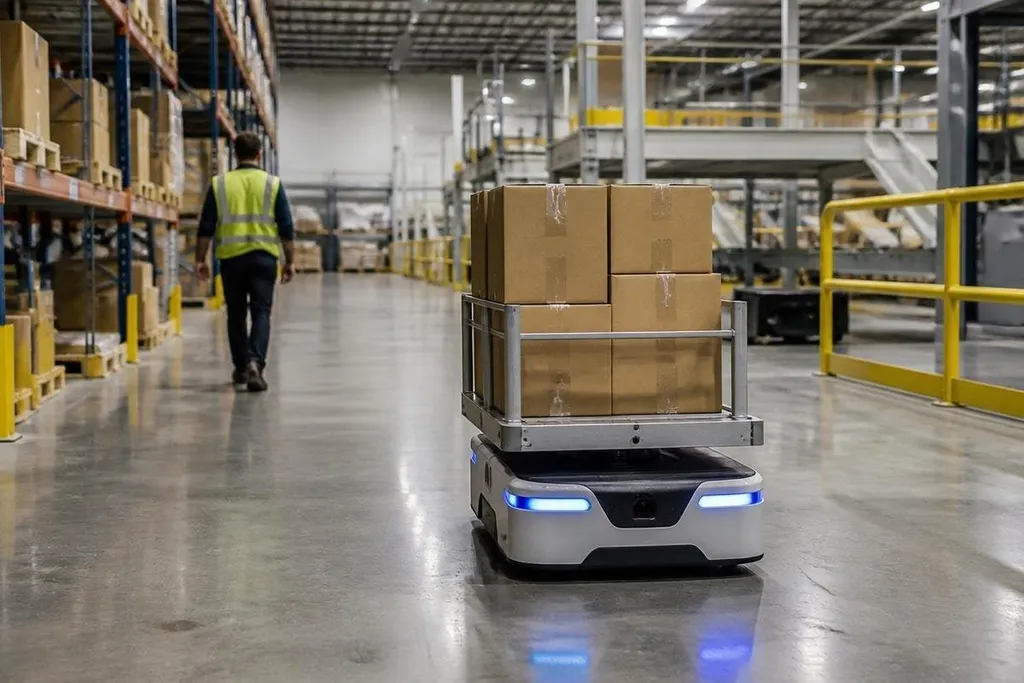
Shipping robots can carry parcels, bring shelves to workers, and move goods between work areas without a driver onboard. They can reduce walking and keep material moving, but they also add software, charging, traffic, and safety tasks that a site must manage.
- Robots can move loads between fixed points
- Workers still handle exceptions and unsafe conditions
- A useful pilot starts with one repeatable route
Where shipping robots help
A warehouse robot usually follows a mapped route with cameras, LiDAR, floor markers, or other sensors. Some models carry bins or carts; others move shelves to a picking station. Automated guided vehicles, or AGVs, follow fixed paths, while autonomous mobile robots, or AMRs, can adjust their route around people and obstacles.
That movement can change a worker’s day. A person who once walked to a storage area may stay at a station while a robot brings the next item. The benefit comes from removing repeated travel, not from removing every human task. Workers still pick, pack, check labels, load equipment, and fix items the robot cannot handle.
Robots also create a steady link between work areas. A machine can move an empty cart back to a packing station or carry completed parcels toward dispatch. The value depends on the route, the load, and how often the task repeats. A robot waiting for a blocked aisle adds little.
A manager judging a shipping-robot pilot needs the route, load, test date, and result beside each claim. Robotics coverage from Robot24.com can place those details beside the machine’s task. That record matters when the work moves to people.
The work that moves to people
The machines do not remove the need for planning. Staff must map routes, set speed limits, mark crossing points, check floor conditions, and decide what happens when a robot stops. Someone also needs to handle battery charging, software updates, damaged loads, and blocked paths.
The handoff between robot and worker deserves close attention. A robot may arrive at the right station but present a bin at an awkward height. A cart may move correctly yet leave too little room for a person to pass. These details affect safety and the time needed for each task.
The system also depends on its surroundings. A wet floor, loose packaging strap, poor lighting, or a changed rack position can affect sensor readings or movement. A site needs a clear way to stop the robot and a trained person who can inspect the problem before work resumes.
Main risks to check
The risks fall into a few connected groups. A moving robot can strike a person, trap a hand near a cart, or block an exit if the site has poor traffic rules. A failed sensor or map can send the machine toward an unsafe area.
A network or software fault can stop several machines at once. Cybersecurity matters too. A connected robot may exchange route data, status information, or commands with other systems. Access controls, update rules, and backup procedures should be part of the site plan rather than a later repair.
Noise and workload deserve attention. A robot may reduce walking but add repeated lifting at a fixed station. That change can shift strain toward the back, shoulders, or hands. Managers need to check the full task, not one robot movement in isolation.
A practical pilot checklist
Before buying or leasing a shipping robot, check these points:
- Define the route: record the start point, destination, load, trip frequency, and conditions that can block travel.
- Set the handoff: decide how a worker loads, unloads, checks, and rejects each item.
- Test the stop: confirm that workers can reach the emergency stop and know when to use it.
- Measure the whole task: include waiting, charging, supervision, recovery, and manual work around the robot.
- Plan failure work: name the person who handles a stalled robot, lost map, low battery, or damaged load.
- Review access: limit system permissions and define how software updates get checked before use.
A small route with repeatable loads gives cleaner evidence than a site-wide rollout. Record travel time, worker travel, stops, manual touches, safety events, and recovery time before changing the process.
The decision
Repeated moves make the most sense when a site has clear pickup and drop-off points, plus enough room for safe traffic. They make less sense when loads vary widely, routes change often, or staff must keep rescuing the system.
I'd approve a pilot only after the site can explain who stops the robot, who fixes the failure, and what work remains for people. The useful result is not a robot count; it is a measured route that stays safe when the warehouse stops behaving as planned.